

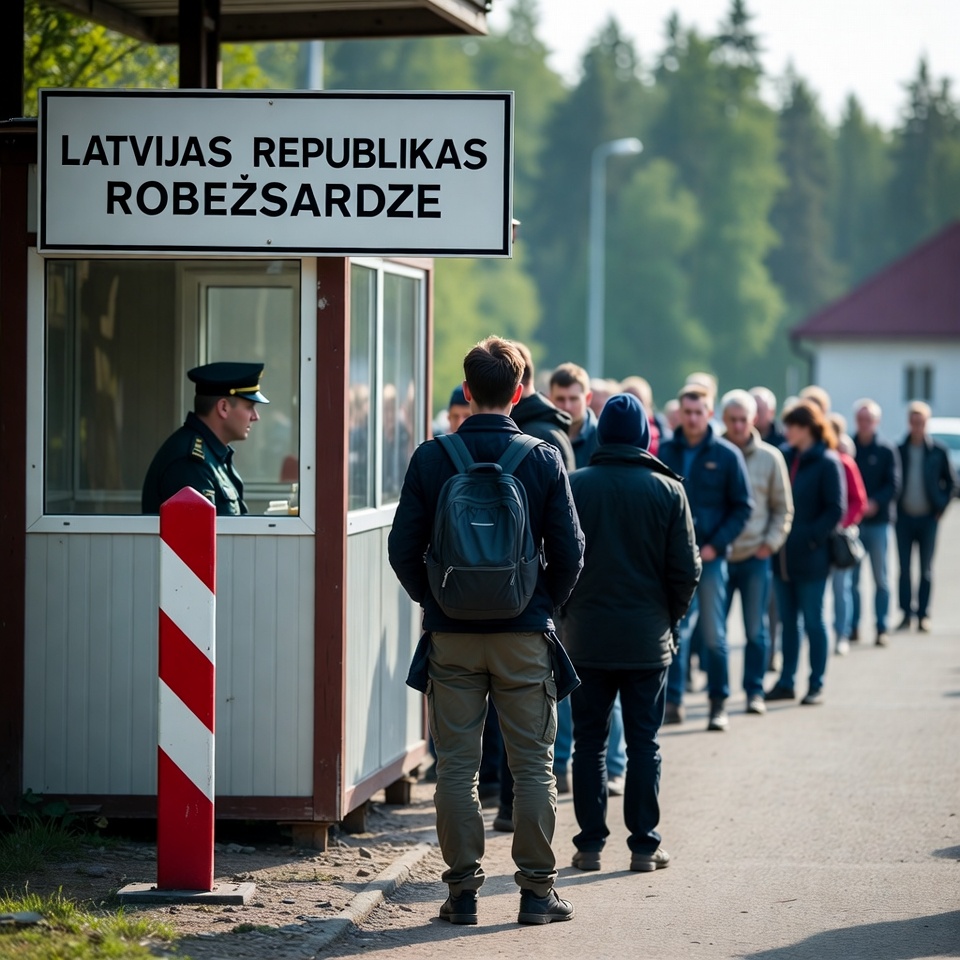
On August 20, 2026, the Saeima of Latvia adopted an entirely new Immigration Law in its final reading. The new version fully replaces the law that has been in force since 2002, substantially updating the rules on entry, residence, employment, and monitoring the stay of third-country nationals in Latvia. The main goal of the reform is to strengthen national security, combat fictitious immigration, improve oversight of migration processes, and bring Latvian legislation into line with EU requirements.
An unexpected development is that the new law will take effect much earlier than originally planned. It was initially expected that the main provisions would come into force only on January 1, 2027, but lawmakers accelerated the process — the new rules take effect as early as September 15, 2026. This means there is now very little time left to prepare and submit documents under the familiar conditions. Let’s look at how these changes will affect different categories of foreigners and what needs to be done to avoid losing one’s status.
WHICH RESIDENCE PERMIT GROUNDS ARE BEING REMOVED
Two programs are being fully removed from the new law:
- Residence permit based on the purchase of real estate in Latvia;
- Residence permit based on a subordinated deposit in a Latvian bank.
If you have already obtained a residence permit on one of these grounds, there’s nothing to worry about. Your residence permit will remain valid until the end of its current registration period. However, once your ID card’s validity expires, under the law’s transitional provisions, you will need to apply for a new five-year residence permit on the same grounds. Important: this must be done before the ID card expires. This provision does not apply to citizens of Russia and Belarus — the law will not allow them to renew a residence permit based on real estate or a deposit.
INVESTMENT IN COMPANY CAPITAL REMAINS, LARGELY UNCHANGED
The residence permit program based on investment in the capital of a Latvian company stays almost the same:
- from 50,000 EUR — in a small company;
- from 100,000 EUR — in a larger company (or one with subsidiary structures),
- plus a one-time payment of 10,000 EUR to the state budget upon initial application.
The main change concerns the validity period. Previously, such a residence permit was issued for up to five years; now it is issued for up to two years, with subsequent renewal on the same terms.
MAIN NEWS: RESIDENCE PERMIT IN EXCHANGE FOR INVESTMENT IN ALTERNATIVE INVESTMENT FUNDS
This is the most notable innovation in the law. A foreigner will be able to obtain a residence permit for up to five years if:
- Investment: at least 150,000 EUR is invested for a minimum of 5 years in an alternative investment fund registered in Latvia;
- State fee: an additional one-time contribution of 10,000 EUR to the state budget.
The law sets out only a general framework. The detailed mechanism — requirements for the funds themselves, risk criteria, the procedure for confirming that the investment has been maintained, and oversight rules — will be established by separate Cabinet of Ministers regulations. Until these secondary legal acts and procedures are finally approved, the instrument remains in a launch/transitional stage.
Important nuance: citizens of Russia and Belarus will not be able to use this particular basis — the restriction was introduced through a separate emergency amendment.
ABOLITION OF ANNUAL REGISTRATION
Under the current law, a residence permit is generally issued for five years, but each year the holder must go through a so-called registration procedure (since the ID card itself is issued for only one year). Under the new law, this system becomes a thing of the past — the residence permit’s validity period will now directly match the ID card’s validity period, with no intermediate annual renewals.
That said, the new terms are not the same for everyone — for some grounds they’ve become shorter than the previous law’s general “ceiling,” while for others they stay at the same level. In most cases the terms have become shorter: under most grounds (including investment in company capital, employment, board membership, and pensioners from visa-free countries), the residence permit will now be issued not for 5 years but for only 2 years. The EU Blue Card will still be issued for 2 years, startups for 3 years, and marriage-based permits for 2 years. The new investment-fund-based permit described above will be issued for a full 5 years right away.
CASE PROCESSING TIME WILL BECOME MORE PREDICTABLE
Under the new law, the Office of Citizenship and Migration Affairs (PMLP) will be able to extend the review period to a maximum of 4 months from the date documents are submitted, with no possibility of a further extension. This is an important change, since under the current law review can, in some cases, drag on for a year.
ONE STATUS INSTEAD OF TWO: NO MORE CONFUSION BETWEEN NATIONAL PERMANENT RESIDENCE AND EU LONG-TERM RESIDENT STATUS
For years, Latvia has had two similar but not identical statuses in parallel — the national permanent residence status, governed by the Immigration Law, and the European long-term resident status, set out in a separate law. They had different requirements for permissible absence from the country and different renewal procedures.
The new law removes this duplication at the terminological level: these are no longer two parallel statuses but one. The term “permanent residence” is retained, but in substance it is now equivalent to EU long-term resident status.
Conditions for applying for permanent residence:
- 5 years of continuous residence in Latvia on the basis of a residence permit.
- Sufficient means to support oneself and dependent family members.
- Latvian language proficiency of at least level A2.
- Additionally — as a separate requirement — a course on Latvian culture and history, completed during the period of residence under the residence permit. The law specifies that this is a course, not an exam as such. There is not yet specific information on exactly how completion of the course will be confirmed in practice (a test at the end, a certificate, etc.).
As for permissible absence, it may now not exceed 10 months within a 5-year period (under the current law, this is 12 months).
WHICH PATHS REMAIN OPEN FOR RUSSIAN AND BELARUSIAN CITIZENS?
The new law introduces a differentiated approach toward citizens of Russia and Belarus.
BELARUSIAN CITIZENS: GREEN LIGHT FOR BUSINESS AND WORK
For Belarusian citizens, the following remain fully open:
- Business immigration: applying for a residence permit as a company board member, paying 25,000 EUR in taxes per year;
- Startups: the startup residence permit program for innovative business;
- Standard employment: ordinary employment-based residence permits;
- The EU Blue Card;
- Education and science: university study and research projects;
- Family reunification with relatives up to the 3rd degree, spouses, and minor children.
RUSSIAN CITIZENS: ROOTS, FAMILY, AND HIGH QUALIFICATIONS
For Russian citizens, the following legal grounds remain:
- Family and historical roots: marriage to a Latvian citizen or non-citizen, or to a foreigner holding permanent residence; dependent minor children and elderly parents.
- Latvian or Livonian ancestry, or the status of a citizen of Latvia as of June 17, 1940, or their descendant.
- Intellectual migration: the EU Blue Card; intra-corporate transfer (transferring executives and specialists within international holding companies to Latvian branches remains permitted); study at accredited universities and participation in research projects.
THE MAIN “LIFELINES” FOR BOTH COUNTRIES
Beyond these basic provisions, the law includes two important mechanisms that will let many Russian and Belarusian citizens extend their stay in Latvia without difficulty:
- Extension of a work-based residence permit: If a citizen of Russia or Belarus is already officially employed in Latvia, has the right to work, has worked for at least the last 3 months before submitting documents, and has had income tax duly paid on their behalf, they have the legal right to request a one-year extension of their residence permit to continue that same employment.
- Humanitarian corridor and state interest: The Minister of the Interior of Latvia has the right to personally grant a residence permit to citizens of Russia and Belarus for up to 3 years, where this is required to comply with international legal norms or is warranted by compelling humanitarian considerations (for example, a security threat in the home country, persecution, etc.).
DOCUMENTS — LATVIAN ONLY ON REPEAT SUBMISSION
One more important practical change: for the initial submission of residence permit documents, English is still acceptable. However, for repeat submissions — renewing a residence permit or applying for permanent residence — documents will need to be submitted in Latvian only. It’s worth planning document translation well in advance rather than leaving it until the last moment before filing.
BY WAY OF CONCLUSION
No single article can cover every detail of the new law — some points inevitably fall outside its scope — so our lawyers are ready to provide more detailed consultations on all aspects of the new law. The law undoubtedly makes the system stricter: more security checks, more integration requirements, tighter control over employers. But there’s a positive side too: the rules become more transparent and predictable, review periods become shorter and clearer, and investors gain a new tool.
Recent News


